
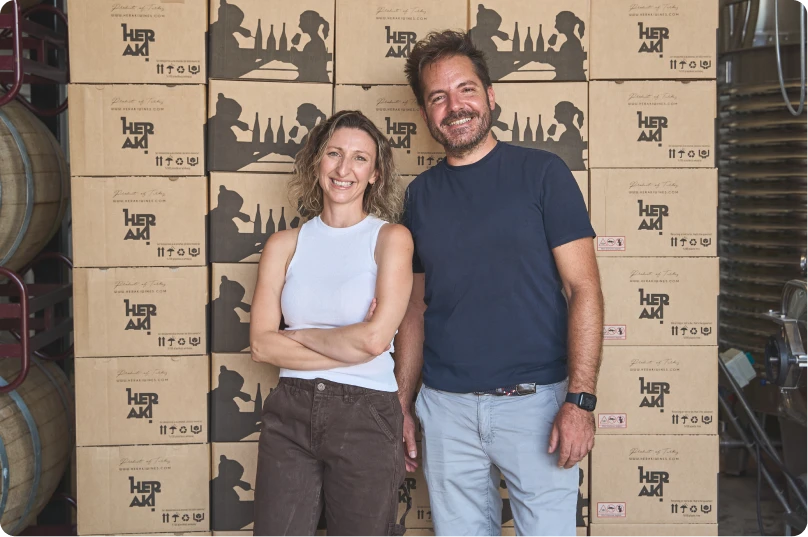
Some wineries begin with a plot of land. Heraki began with a partnership — between two people, and between two winemaking cultures.
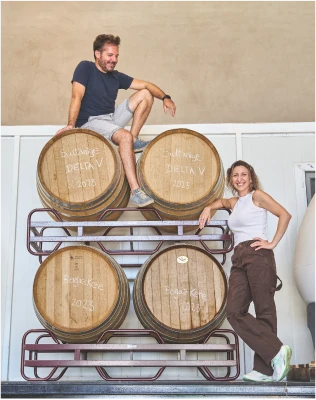
Fulya Akıncı, from Türkiye, and José Hernández, from Spain, met as students of oenology in Bordeaux. What followed was the kind of apprenticeship that can’t be rushed: five years of harvests chasing the seasons across both hemispheres, learning the craft in cellars around the world. In 2014 they settled in Türkiye, and rather than plant a flag straight away, they spent another five years listening — travelling the country’s regions, working with different growers, getting to know the old vines and native grapes that most of the wine world had never heard of. Only then, in 2019, did they finally build something of their own.
That patience is the whole point of Heraki. The winery exists to give voice to Türkiye’s indigenous grapes and, just as importantly, to the people who have tended them for generations.
The heart of Heraki lies in the Çal district of Denizli, where the vineyards climb to 800–950 metres. These aren’t estate blocks but small, carefully chosen parcels belonging to growers scattered across different villages — bush vines between 35 and 80 years old, of Sultaniye, Çal Karası and Boğazkere. They’re dry-farmed, as they always have been here, standing up to a severe continental climate on soils of clay and limestone. One of the couple’s stated aims is to protect the value of these landscapes and honour the life’s work of the farmers behind them, which is why so many wines carry the imprint of a single village or a single old vineyard.
The cellar itself sits in Alaşehir, in the Aegean province of Manisa — a modest operation of around 20,000 bottles, deliberately fitted with small vessels so that each vineyard plot can be fermented and kept apart. Winemaking is low-intervention by conviction rather than fashion: native character is coaxed out, not manufactured. Ageing happens in whatever suits the wine — ovoid tanks, French barrels, oak casks of various sizes and ages — always in service of transparency to place.
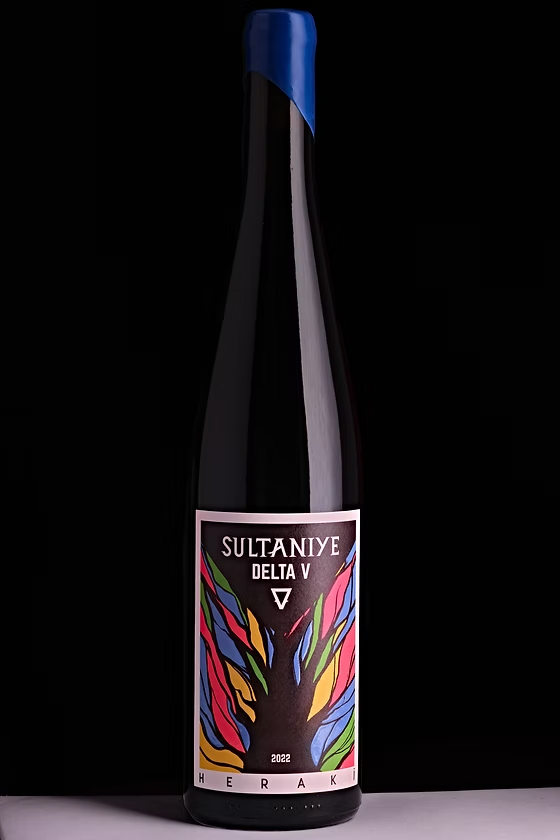
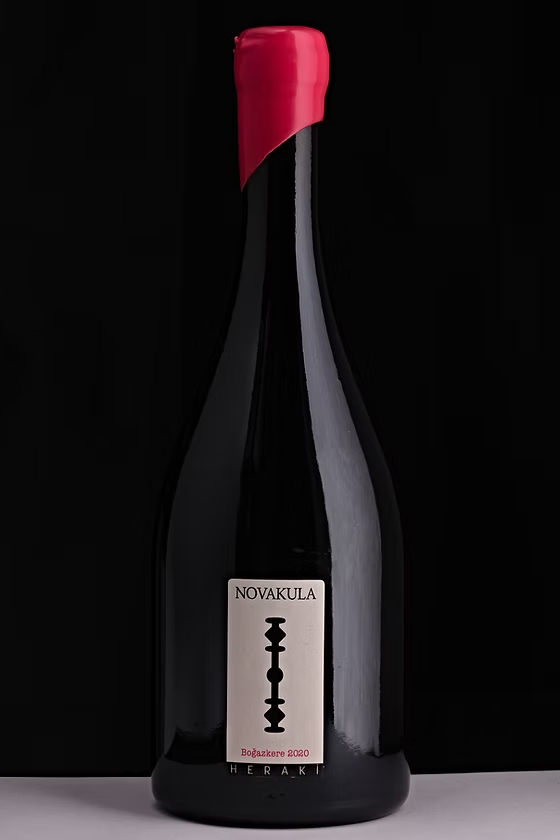
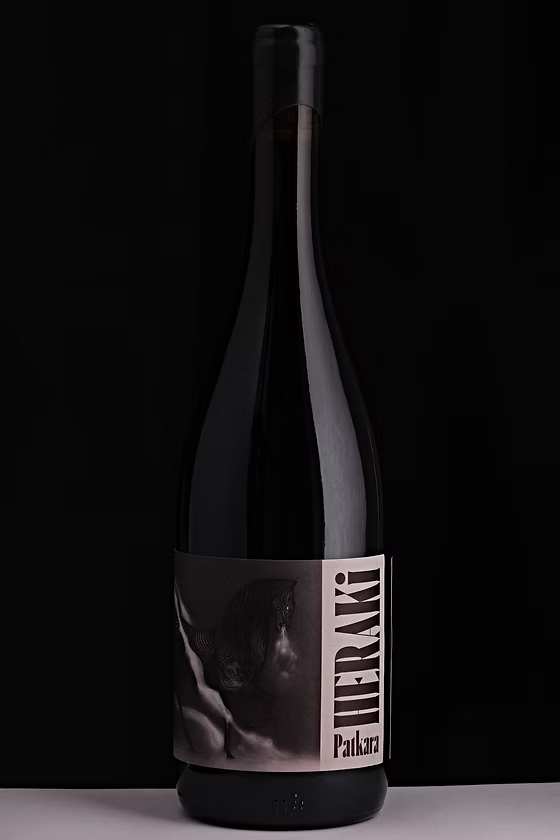
The range tells the story neatly. The unoaked AKUARELA wines are the purest expression of the house philosophy, showing grapes like Sultaniye, Çal Karası, Karasakız and Boğazkere entirely on their own terms, aged only in ovoid tanks so nothing stands between the drinker and the vineyard. Alongside them sit more ambitious cuvées: DELTA V, a Sultaniye aged on its fine lees, and NOVAKULA, a serious, long-aged Boğazkere that spends up to eighteen months maturing before release. With the backing of the Heritage Vines of Türkiye project, the family has continued to rescue and bottle rarities — Karasakız from Bayramiç, and Gök and Patkara from vines pushing well past sixty years old.
The result is a portfolio that feels like a field guide to Anatolia’s forgotten grapes — made by two people with world-class training who chose, of all places, to put down roots here.
Foxes & Grapes takes its name from the ancient Greek fable by Aesop — a story about desire, perspective, and how we sometimes convince ourselves that something just isn’t worth it simply because it feels out of reach.
In 2025, we opened Foxes & Grapes Wine Bar in Brussels with a simple philosophy: wine should be enjoyed, explored, and shared by everyone.
Within our first year, the bar received a Red Star and later a Silver Star from Star Wine List, and was recognised as a finalist for Best Newcomer Wine Bar in Belgium.
Operating the bar also helped us reflect on the long-term direction of the project. The traditional wine bar model did not fully align with the broader vision we had for Foxes & Grapes.
So we decided to evolve.
Today Foxes & Grapes is growing into a platform built around three pillars:
What began as a wine bar is becoming something bigger: a space where curiosity, discovery, and great bottles come together.
And this is only the beginning.